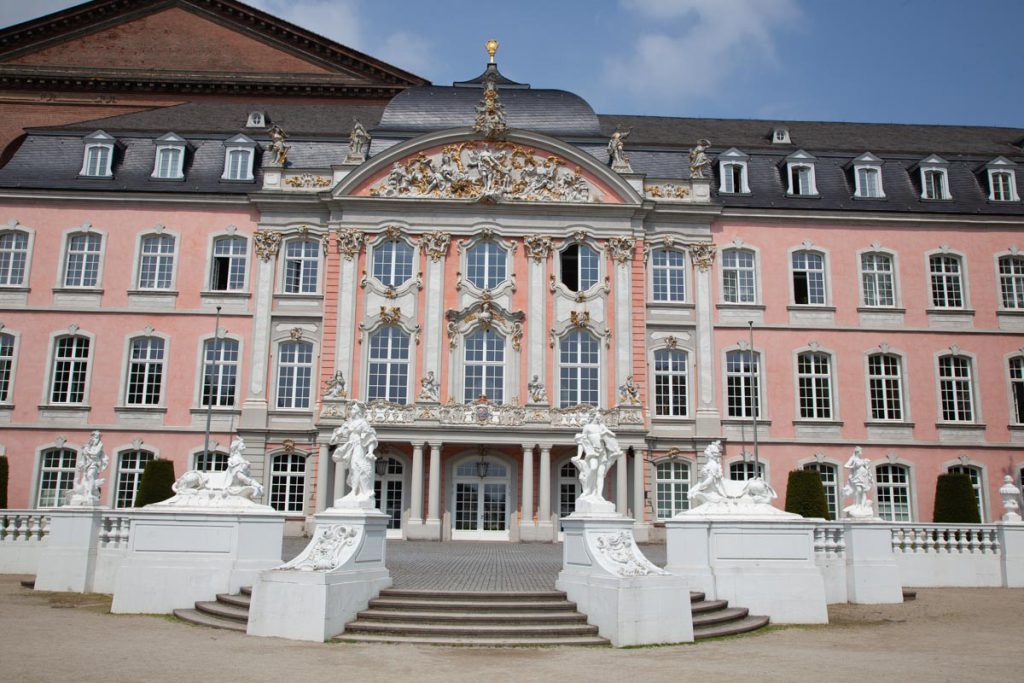
The Electoral Palace in Trier, was the residence of the Archbishops and Electors of Trier from the 16th century until the late 18th century. It now houses various offices of the federal government and often hosts classical music concerts.
In the late 16th century, archbishop Johann von Schönenberg planned building a residence in the style of the German Renaissance for which parts of the Medieval fortress, as well as many houses, were demolished. It was only because the Roman walls proved to be resistant that some of them were incorporated in the new structure. Von Schönenberg’s successors, Lothar von Metternich and Philipp Christoph von Sötern, completed the lower palace (Niederschloss) around 1650. The new residence was known as Saint Peter’s Castle (St. Petersburg), after the town’s patron saint. A chapel dedicated to Saint Lawrence stood on the south-west corner. In the same period work had started on the upper palace wings (Hochschloss) but this project was halted as a result of the Thirty Years’ War. At this time, the bishops preferred their Koblenz residence at Ehrenbreitstein, which was considered safer.